
Billing · Costs
What Does Medical Billing Cost a South African Practice?
Published 13 July 2026 · 6 min read
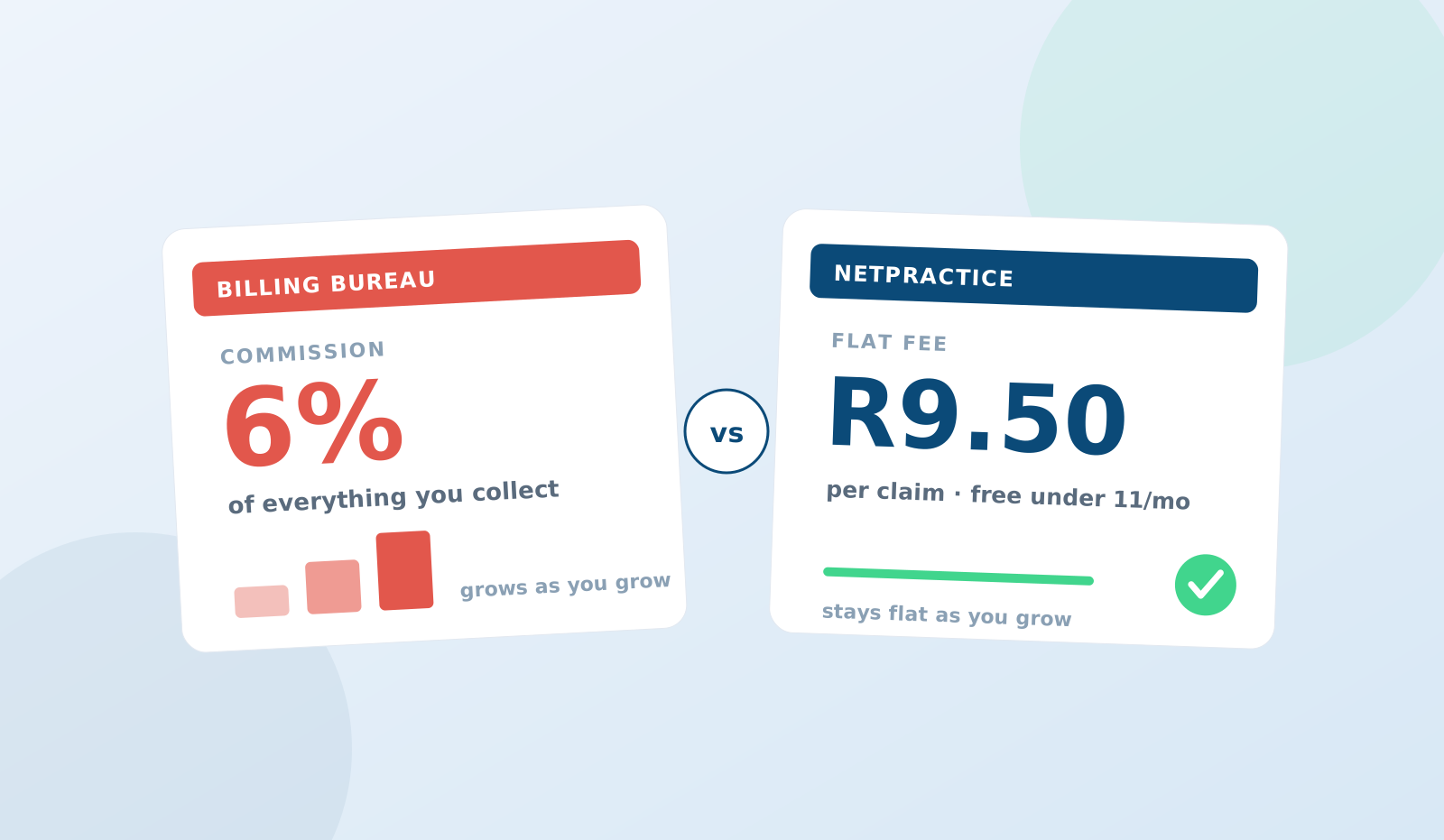
Ask most South African practice owners what their billing costs and you'll get a shrug, not a number. That's because the biggest billing expense is usually a percentage skimmed off every payment before it reaches you - so it never lands as a line on an invoice you actually look at. Do the maths once, though, and it's often one of the largest fixed costs in the practice.
Here are the three ways practices pay to get their claims out the door, what each really costs, and how to work out your own number.
The three ways practices pay for billing
- Percentage commission (a billing bureau) - you hand claims to a bureau and they take a cut of what they collect, commonly 4% to 8%. Convenient, but the fee scales with your revenue, not with the work.
- In-house staff - a biller (or a clinician doing it after hours) plus software and training. A fixed monthly cost whether you bill 50 claims or 500, and it walks out the door when the person resigns.
- Flat per-claim software - you submit the claims yourself in a few clicks and pay a small, fixed fee per claim. Predictable, and it never rises just because you had a good month.
The hidden cost of "just a percentage"
A percentage feels painless because you never write the cheque - it's deducted before payout. But run the numbers on a typical practice:
- 300 claims a month, averaging R500 each = R150 000 collected.
- At a 6% bureau commission, that's R9 000 a month - R108 000 a year.
- Grow to R250 000 a month and the same 6% becomes R15 000 a month - you're paying more for the identical work, simply because you earned more.
That's the catch with commission: it's a tax on your success, not a price for a service. The effort to submit a R200 claim and a R2 000 claim is the same - so why should the second one cost you ten times more to bill?
What you're actually paying for
Strip it back and billing is three jobs: submit the claim correctly, track its status, and follow up on anything that bounces. Modern software does the first two automatically and makes the third a two-minute fix - which is exactly the part a percentage commission was historically meant to cover. When the software handles it, paying a percentage for it stops making sense.
The flat-fee alternative
NetPractice charges a flat fee per claim - free under 11 claims a month, then R9.50 per claim. No percentage, no monthly plan, no contract. Take the same practice as above:
- 300 claims a month on NetPractice ≈ R2 850 (the first 11 are free).
- Versus R9 000 at a 6% bureau - about R6 000 saved every month, roughly R74 000 a year.
- And when you grow to R250 000 a month, your billing cost barely moves - the saving gets bigger, not smaller.
You also keep something a bureau can't give you: claims are submitted in real time with live accepted, rejected and reversal status, so you see and fix problems the same day instead of chasing a third party at month-end.
How to work out your own billing cost
- Find your current rate - the percentage your bureau takes, or your biller's monthly cost plus their software.
- Multiply by your monthly collections (for a percentage) to get the rand figure.
- Count your monthly claims and multiply by a flat per-claim fee for comparison.
- Compare the two - and remember the percentage grows with you, while the flat fee doesn't.
Frequently asked questions
How much do billing companies charge in South Africa?
Typically 4% to 8% of what they collect on your behalf. Because it's a percentage, the cost rises as your practice grows, even though the work per claim is unchanged.
Is flat-fee billing really cheaper?
For most active practices, clearly - and the gap widens the more you bill, since a flat per-claim fee doesn't scale with your revenue the way a commission does.
Stop paying a percentage of every payout. Bill your claims on NetPractice - free under 11 a month, then a flat R9.50 →