
Choosing software · Cost
Is there free medical billing software in South Africa?
Published 21 August 2026 · 6 min read
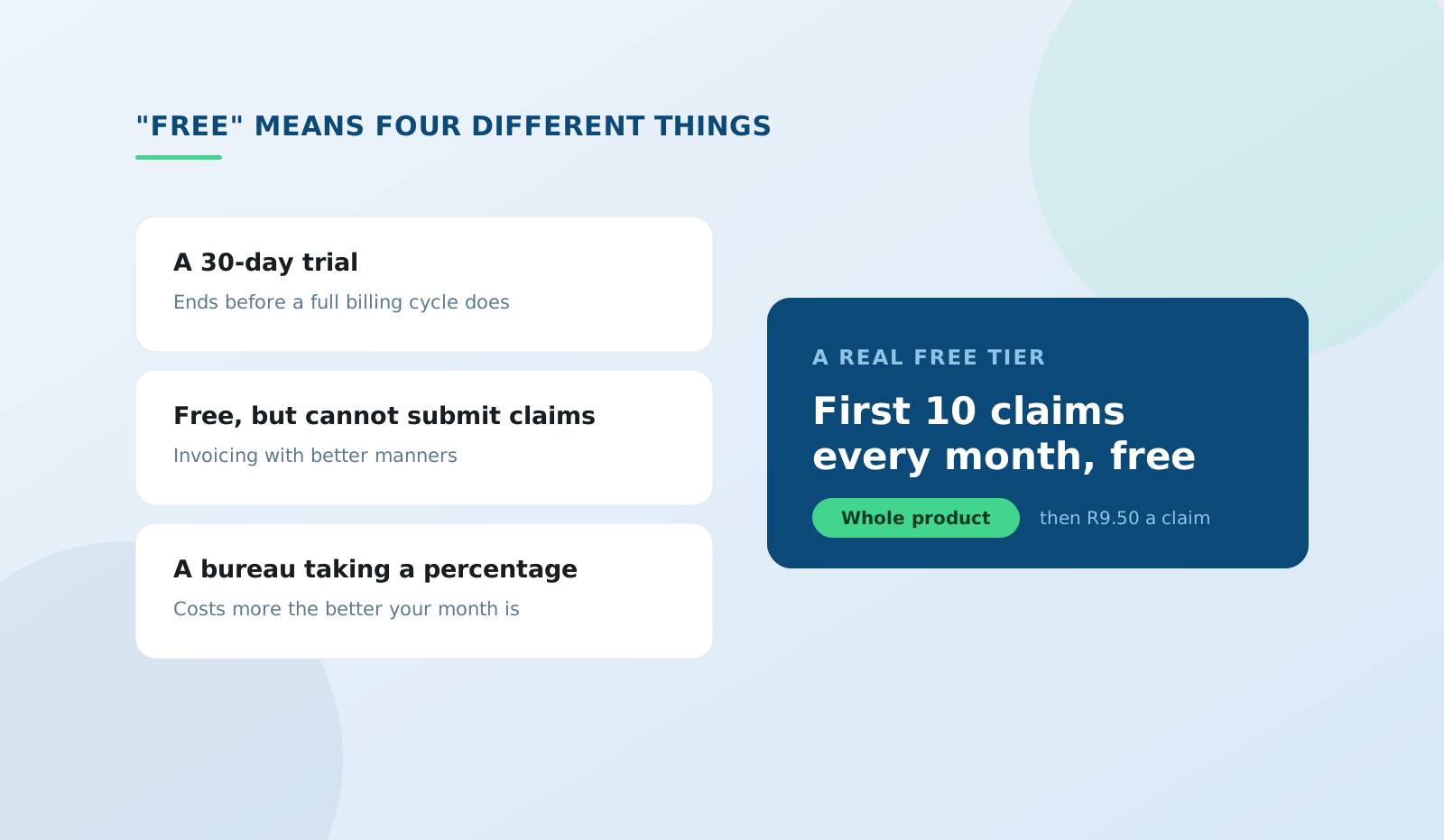
Short answer: almost none, and it is worth understanding why before you spend a week evaluating something that cannot do the job. Submitting a claim to a South African medical scheme costs money on every single transaction, so software that submits claims for you is paying a real cost each time. A product with no revenue model cannot absorb that indefinitely.
That does not mean everything advertised as free is dishonest. It means "free" is doing a lot of different jobs in a lot of different sentences, and the differences matter to a practice.
The four things "free" usually means
1. A time-limited trial
Thirty days, sometimes sixty. Perfectly reasonable, and often the right way to evaluate something. The catch is that a month is not long enough to see the thing that actually matters: how the software behaves across a full billing cycle, including a payment run, a batch of rejections and a month-end reconciliation. If you trial something, trial it over a period that includes those.
2. A free tier that does not submit claims
This is the most common one, and the easiest to miss. The free version generates invoices and keeps a patient list, which looks like billing software, but scheme submission sits behind the paid plan. For a cash-only practice that may be genuinely all you need. For anyone billing medical aids it is a spreadsheet with better manners, and you will discover that in week two.
The question to ask is not "is it free" but "does the free version submit a claim to Discovery and show me the outcome".
3. Free software, paid submissions
The licence costs nothing and each claim carries a transaction fee. This is an honest model and often a good one, but it is not free, and the per-claim number is the only figure that matters. Get it in writing, and check whether it changes by scheme or by claim type.
4. A billing bureau taking a percentage
No software fee at all, because the bureau takes a cut of what it collects for you. Genuinely free to start, and for some practices the right answer, especially if you have nobody to do billing. But a percentage rises with your turnover, so the better your month the more you pay, and you are handing over the relationship with the scheme along with the admin. We compared the models with the maths in what medical billing costs in South Africa.
What a real free tier looks like
A free tier is meaningful when it gives you the whole product up to a usage limit rather than a reduced version of it. Nothing switched off, nothing held back for the paid plan, and no clock running.
That is how NetPractice does it: your first 10 claims every month are free, on the complete product, including real-time submission to the schemes and the accepted or rejected outcome back in seconds. After 10 it is R9.50 a claim with no monthly fee and no contract. A quiet month, a holiday or a stretch of leave costs you nothing, because the free allowance resets every month rather than expiring once.
For a part-time practice, a practitioner just starting out, or rooms that bill a handful of medical aids and see the rest privately, that can genuinely be free indefinitely. We would rather you started there than not at all.
Five things to check before you sign up for anything free
- Does it submit to South African schemes? Not "does it do billing" but does it submit, and does it show you the verdict. If the answer involves exporting a file and uploading it somewhere else, that is your afternoon, every day.
- Does the free part expire? A recurring monthly allowance and a one-off trial are completely different propositions.
- Can you get your data out? Patient list, visit history, balances. Ask for the export format before you put a year of work in. Software you cannot leave is not cheap at any price.
- Is support included? Free tiers often route you to a help centre and nothing else. When a claim is stuck and the money is real, that matters more than you expect.
- Does it know your discipline? Allied and paramedical practices bill a different tariff-code form from medical specialists, and software that does not handle it produces blanket rejections. See how the 72-prefixed physiotherapy codes work for what that looks like in practice.
When free is the wrong question
Here is the uncomfortable arithmetic. If billing software costs you R400 a month and stops one claim a month from being written off, it has paid for itself several times over on a single consultation. Claims in South Africa go stale four months after the date of service, and a rejection nobody noticed becomes a permanent write-off rather than a late payment.
So the number to compare is not the licence fee. It is the licence fee against the value of the claims you are currently losing. Most practices have never measured the second one, which is precisely why the first one feels like the important number.
If you want to check, pull your last three months of remittance advices and add up the rejected and short-paid lines nobody went back to. This walks through how to read them. That figure is the real budget for billing software, and it is usually a lot bigger than the quote.
Frequently asked questions
Can I run a practice on invoicing software instead?
You can bill cash patients on almost anything. The moment you bill medical aids you need scheme submission, and general accounting or invoicing software does not do it. Practices that try end up double-capturing every visit.
Is open-source medical billing software an option in South Africa?
Open-source options exist internationally, but they are built for other countries' payers. The South African scheme connections, tariff structures and ICD-10 requirements are what make local billing hard, and that is exactly the part they do not have.
What is the cheapest way to bill medical aids properly?
For low volumes, a per-claim product with a real free allowance, because you pay in proportion to the work. As volume grows the comparison shifts, and it is worth redoing the maths once you are past a few hundred claims a month.
Start on the free allowance and see what it does with a real claim. Create an account - your first 10 claims each month are free →